
Reinforcement Is More Than Rewards
This is the fifth and final article in a series exploring change management through a behavioral science lens using ADKAR as a framework.
Mention reinforcement during a change initiative and someone will say:
"We don’t have the budget for that. We already give out gift cards during the holidays.”
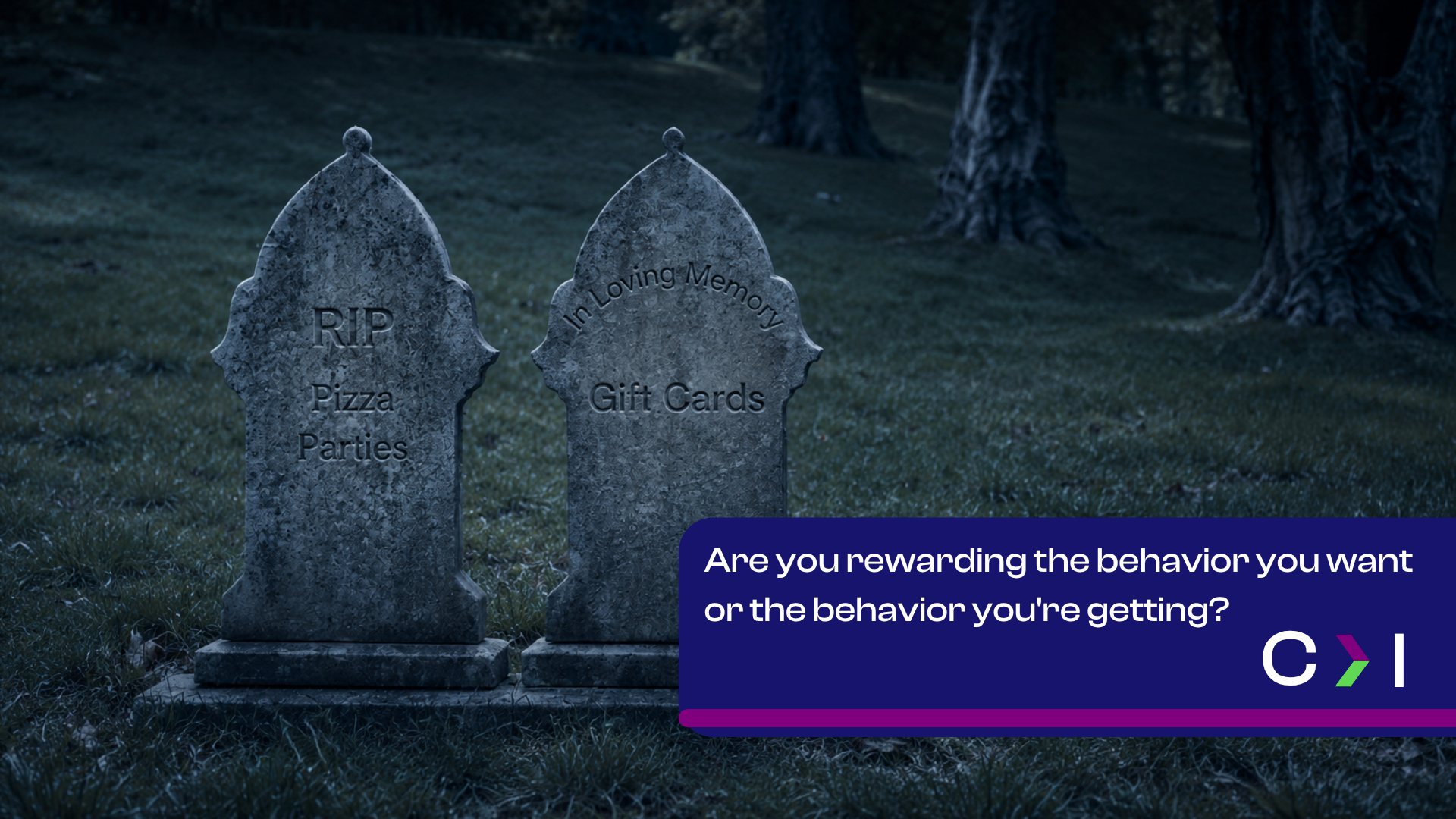
It’s a fair response. Reinforcement is often associated with gift cards, bonuses, employee recognition programs, and pizza parties.
But reinforcement isn't defined by rewards. It's defined by consequences that make a behavior more likely to occur again in the future.
That distinction changes the conversation entirely.
Reinforcement Doesn't Have to Cost Money
One of the biggest misconceptions about reinforcement is that organizations need to spend money to encourage behavior. Sometimes incentives can help, but people don't repeatedly perform behaviors because they received a bonus once. They repeatedly perform behaviors because those behaviors work.
That’s why the most powerful reinforcement systems are built directly into the work itself.
Imagine a company implements a new customer intake process. The old process required employees to enter the same information multiple times, track requests through email, and spend time following up with different departments for updates.
The new process automates handoffs, eliminates duplicate work, and provides real-time visibility into request status. Employees save time. Customers receive faster service. Problems get resolved more quickly. In this scenario, employees don't need additional incentives to continue using the new process.
Designing Better Consequences
A useful starting point is mapping the current process and identifying sources of friction, delay, rework, and unnecessary effort.
Ask questions like:
How many approvals are required?
How many handoffs occur between teams?
How many systems require duplicate data entry?
How often do employees need to wait for information before moving to the next step?
Once those friction points are identified, you can begin redesigning them.
Could Step 2 move directly to Step 4?
Do three approvals really add value?
Could information be entered once instead of three times?
Could employees receive immediate feedback instead of waiting for a monthly review?
Every process creates consequences. Some encourage desired behaviors. Others unintentionally reinforce delays, workarounds, and frustration.
When organizations redesign a process, they're changing those contingencies. And when the desired behavior becomes easier, faster, or more effective than the alternative, reinforcement is built directly into the workflow.
Feedback as Reinforcement
Some consequences are built directly into the work. Others need to be made visible.
Imagine a customer service team implements a new process designed to reduce response times. Each month, the team reviews a dashboard showing response times decreasing and customer satisfaction increasing.
No prizes are awarded.
No bonuses are attached to the metric.
Yet team members begin discussing ways to improve the numbers even further.
Why?
Because progress can be reinforcing.
The dashboard provides evidence that their effort is making a difference. It connects behavior to outcomes. In behavioral science, feedback is often one of the simplest and most cost-effective ways to support behavior change because it helps people see the consequences of their actions.
Putting It Into Practice
Throughout this series, we've explored ADKAR through a behavioral science lens. While communication, training, and stakeholder engagement are important, sustainable change often means looking beyond traditional change management activities and examining the contingencies built into the work itself.
At Change Impact Partners, we help organizations do both. We combine change management, behavioral science, and process improvement to help clients create lasting adoption and stronger business outcomes.
Because understanding change is important. Designing for it is what creates ROI.
Curious what this looks like in practice?
The Dashboard Isn't the Change
This is the fourth article in a series exploring change management through a behavioral science lens using ADKAR as a framework.
Have you ever worked for a “metrics-happy” organization? I’m talking PowerBI, Tableau, a CRM, and that department that insists on still using Excel. You’ve got pie charts and color-coded bar graphs that show frequency counts of everything from customer complaints to the number of coffee pods consumed in the break room.
Organizations love metrics.
But during a change initiative, one of the most important questions often gets overlooked:
What exactly are we trying to measure? And why?
We’re pro-metrics ourselves, but measurement for the sake of measurement can at best waste valuable time. At worst, it can change the strategic focus of an organization when that wasn’t the intention.
Oftentimes when metrics do show up in change management initiatives (which they don’t always), they function more as a checklist of change activities. Were discovery workshops conducted? Yes. Was training completed? Yes. 100% across the board.
But from a behavioral science perspective, ability isn't measured by what people know. It's measured by what people do. If a change is successful, not only should employees be behaving differently than they were before; their behavior also should contribute to the company’s business objectives.
Behavior or Outcomes?
There are two common ways organizations can measure the impact of a change. The first is to measure the behavior itself.
For example:
Percentage of requests submitted through the new workflow
Percentage of employees using the new intake form
Percentage of customer handoffs completed using the new process
These measures tell us whether people are working differently. This is useful when employees are learning new skills or you need to be sure they’re engaging in the right behaviors to get results.
The second approach is to measure the outcomes those behaviors are intended to produce.
Examples might include:
Customer satisfaction
Revenue
Quality scores
These measures tell us whether the change is producing value for the organization. They're particularly useful when the result matters more than the specific behaviors used to achieve it.
In some cases, organizations may choose to measure both behaviors and outcomes (when safety or compliance are on the line).
Measurement in Practice
Let's imagine a company is implementing a new customer intake process. During change planning, the project team identifies two goals:
Reduce customer onboarding time.
Improve customer satisfaction.
Those are both outcome measures.
The challenge is that it may take months before those outcomes begin moving. If onboarding times remain unchanged after launch, leaders need a way to determine whether the problem is the new process itself or whether employees simply aren't using it yet.
To address this, the team decides to measure behavior for the first eight weeks after go-live.
They track:
Percentage of customer records entered through the new workflow
Percentage of required intake fields completed correctly
Percentage of handoffs completed using the new process
These measures provide immediate feedback about whether employees are performing the new behaviors. After eight weeks, adoption is consistently above 90%. At that point, the team shifts its attention to onboarding times and customer satisfaction scores.
Why?
Because once they're confident the behavior is occurring, the more important question becomes whether the behavior is producing the desired business result.
This isn't about choosing behavior measures over outcome measures. It's about selecting measures that answer the questions you're trying to answer at a particular point in the change process.
The Ability Question
One of the reasons ability can be difficult to measure is that it sits between behavior and results. If employees aren't performing the new behavior, it's hard to argue they have the ability to do it consistently. If employees are performing the new behavior but the desired results never materialize, it's worth asking whether the behavior was connected to the right outcome in the first place.
This is why the measures we choose matter.
They're not just helping us evaluate a project. They're helping us answer a fundamental question about the change itself:
Can people successfully perform the new way of working?
That's really what ability is trying to answer.
When your organization measures the success of a change initiative, are you measuring the behaviors that drive results, the results themselves, or both?
Curious what this looks like in practice?
When New Rules Meet Old Habits
This is the third article in a series exploring change management through a behavioral science lens using ADKAR as a framework.
Humans are rule-governed beings. We love rules because they give us predictability and a clearer path for decision-making. In behavioral science, a rule is simply a description of that contingency: if I do X, then Y will happen.
"If I need approval, I email Charlotte."
"If the system is down, I use a spreadsheet."
"If I need an exception, I talk to Javier."
Organizations run on rules, and if we reframe an organizational change to a rule change, we can see why some of those changes face such resistance.
How Rules Become Habits
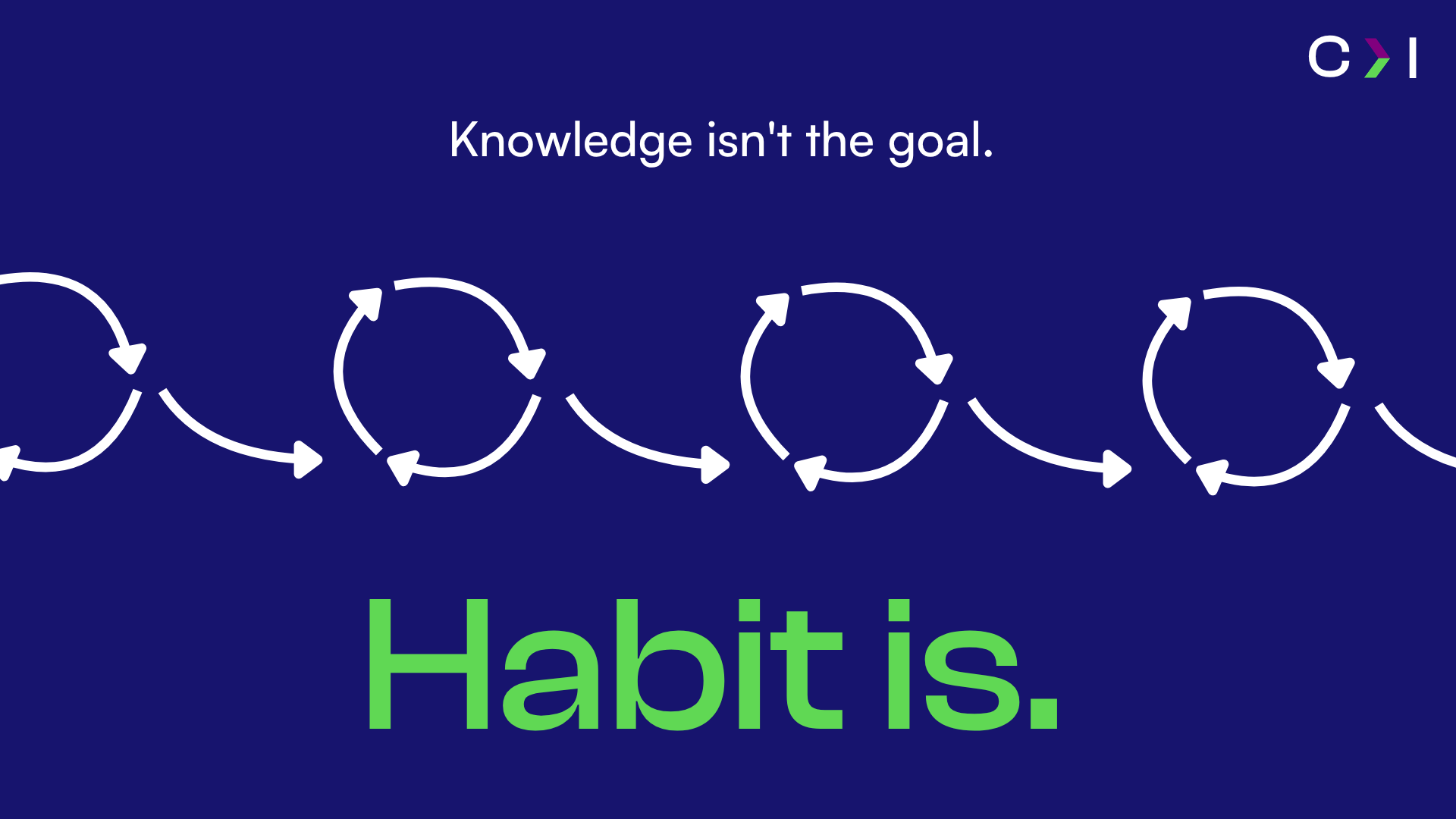
Whether rules are formal or informal, people learn them over time. They figure out what works, what doesn't, who to ask for help, where to find information, and how to navigate obstacles. As those behaviors repeatedly produce successful outcomes, they become habits.
Then a change initiative comes along and asks employees to do something different. But organizations aren't just introducing new rules. They're asking employees to replace deeply ingrained patterns of behavior.
This is where resistance creeps in.
Organizations often assume that once employees understand a new rule, behavior will naturally follow. But understanding a rule doesn't erase years of experience with the old one.
An employee may fully understand that requests should now be submitted through ServiceNow. They may agree with the change and even support it. Yet when a customer is waiting, a deadline is approaching, and Charlotte is sitting two desks away, they email Charlotte.
Not because they forgot the rule.
Because that's the behavior their environment has reinforced hundreds of times before.
Making New Rules Visible
So, what do we do?
We document new rules in procedures, process maps, job aids, workflows, decision trees, and training materials. We explain what's changed, what employees should do instead, and what outcomes they can expect.
In other words, we make the new contingencies visible.
But documentation alone isn’t enough. The organization also has to behave consistently with those new rules.
If the new process says requests should be submitted through ServiceNow, but Charlotte continues responding to emails, employees receive two competing messages.
One message is written down.
The other is reinforced by experience.
And experience usually wins.
This is why knowledge is about more than communicating information. Employees don't just need to understand the new rule. They need clarity about which contingencies are now in effect. That clarity comes from governance and accountability systems that align what’s documented with what will actually happen.
What Rules Are Actually Governing Behavior?
Knowledge during a change isn't just knowing the new rule.
Knowledge means understanding which contingencies are actually in effect. If an employee in your organization followed an old process tomorrow, what would happen? If the answer is “nothing”, then new contingencies haven’t been established yet.
And if the contingencies haven't changed, the behavior probably won't either.
Curious what this looks like in practice?
The Culture You're Building Through Change
This is the second article in a series exploring change management through a behavioral science lens using ADKAR as a framework.
Something we’ve heard repeated a lot in change management initiatives is some variation of the phrase “We know not everyone is going to love this change”. That’s probably true, but leaders should be curious about the alternative. What if employees did see value in the change? What if their first thought was “This will make things so much easier”? That response isn't something organizations should hope for. It's something they should design for.
So, what does a “desire” to change really mean? In behavioral science it means that participation feels worthwhile. People don't change their behavior just because they understand the reason for a change. They change their behavior when they believe the future state will be better than the current one, or when continuing the current behavior becomes less valuable than adopting a new one.
Why should organizations intentionally design for this? Because the way that organizations handle change not only sets a precedent for future changes, it shapes the entire culture of the company.
The Cost of Moving Forward Anyway
Let’s image a scenario: A company implements a new CRM system. During the rollout, employees raise concerns about additional administrative work, workflow bottlenecks, and impacts to customer response times. Leadership acknowledges the concerns but moves forward without making meaningful adjustments. The system gets implemented, and the project is considered complete.
But employees learn something from the experience.
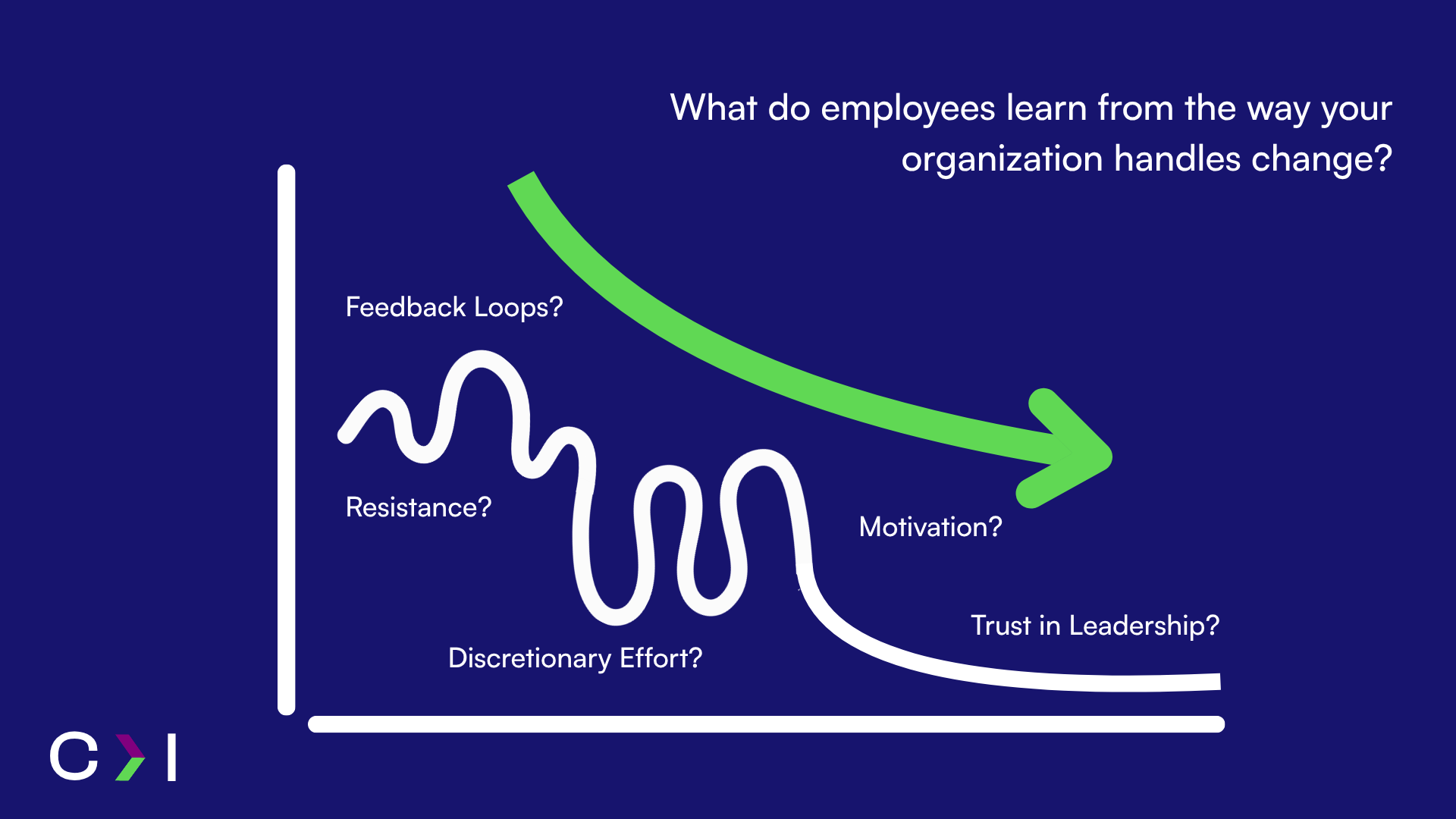
They learn that decisions are made at the top and feedback has little influence on the outcome. The next time a change is introduced, fewer people speak up. Managers stop escalating concerns because they don't expect anything to change. Turnover increases. Glassdoor reviews worsen. Recruiting becomes harder, and the quality of new hires declines. Ultimately, the company pays the price for failing to create the conditions that make participation in changes worthwhile.
Behavioral scientists refer to these patterns as interlocking behavioral contingencies. In simple terms, the way leaders respond influences how managers respond, which influences how employees respond. Over time, those interactions create larger patterns across the organization.
The aggregate product of those interactions is not resistance to a single project. It's culture.
Desire matters because every change teaches employees whether participation is worth the effort.
It's not just about whether employees support the current change. It's about whether the organization is creating a culture that makes future changes easier or harder to implement.
Designing the Culture You Want
This raises an important question for leaders: What kind of culture are you creating when your organization asks people to change?
One where employees surface concerns early? Or one where they keep concerns to themselves because they've learned nothing will change?
One where future changes are met with trust? Or one where they're met with skepticism before they've even begun?
Every change teaches employees something.
The question is whether you're intentionally designing those lessons or leaving them to chance.
Curious what this looks like in practice?
The Problem With Change Communication
This is the first article in a series exploring change management through a behavioral science lens using ADKAR as a framework.
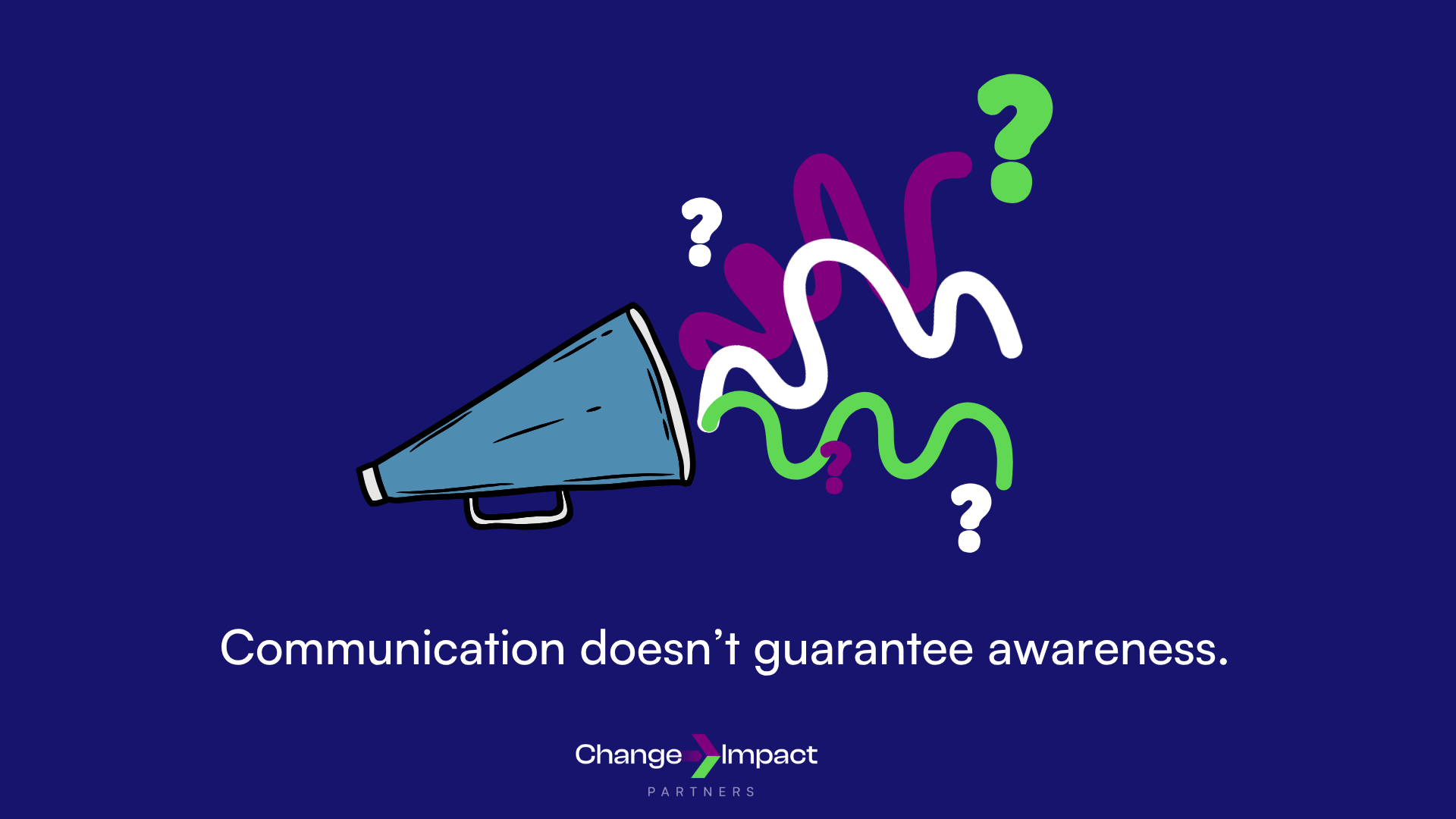
One of the first goals of any change initiative is creating awareness. Most organizations respond by creating more communication. They send emails, hold town halls, create presentations, and share project updates.
Communication is important, but awareness is about more than delivering information.
People are constantly surrounded by competing priorities, deadlines, meetings, customer requests, and existing ways of working. Every day, these signals compete for attention.
Behavioral scientists refer to this as stimulus control.
While the term sounds technical, the idea is simple: the environment influences what people pay attention to and how they respond. Who delivers a message, where it's delivered, and how it's delivered can be just as important as the message itself.
A request from a manager often gets more attention than a project email. A discussion during a team meeting may have more impact than a newsletter. A demonstration can be more memorable than a slide deck.
That’s why awareness isn't just about what you communicate. It's also about who communicates it, where it's communicated, and how it's experienced.
A Common Mistake
I recently worked on a project where a bank was moving technology lifecycle management activities from spreadsheets into ServiceNow. Like many organizations, the initial assumption was that success would depend on making sure employees received enough information about the change.
Before developing a communication strategy, we did a series of change readiness workshops with different stakeholder groups. Participants responded to questions related to awareness, sponsorship, knowledge, resistance, and other factors that could affect adoption. We then analyzed the results to identify the greatest risks and understand what was driving them.
Only 43% of employees understood why now was the right time to move from spreadsheets to ServiceNow. And only 38% agreed they understood how the work they completed in spreadsheets today would be handled in the new system.
When we looked deeper into the results, we saw a pattern. Project updates were primarily being shared through email, but employees were turning to their managers with questions about the change. Managers reported feeling unprepared to answer those questions or explain how the change would affect day-to-day work.
Taken together, the results pointed to a gap between how information was being delivered and how employees were actually looking for it.
More Than a Message
From a behavioral science perspective, this is one example of stimulus control. Employees were receiving project communications, but their managers had a greater influence on how they interpreted and understood the change. So, instead of creating one communication plan for everyone, we focused on getting the right information to the right people through the people they were already turning to for answers.
Employees received demonstrations, process walkthroughs, and examples showing exactly how their work would be completed in ServiceNow. Rather than relying solely on project updates, we delivered most of this information through manager-led discussions and interactive sessions where employees could ask questions and see the future process in action.
Managers received talking points, FAQs, and discussion guides so they could confidently answer questions and reinforce key messages with their teams.
In other words, we didn't just tailor the message. We tailored who delivered it and how it was delivered.
What Really Creates Awareness?
Awareness isn't just about sending information. It's about intentionally designing how employees encounter it. The people, channels, and experiences surrounding a message influence whether it captures attention and how it's interpreted.
So, before you create another communication plan, consider this:
Are you communicating in the way employees are most likely to learn, or simply in the way that's easiest for you to communicate?
Curious what this looks like in practice? Learn more about Change Impact Partners and our approach.
Why Change Management Needs Behavioral Science
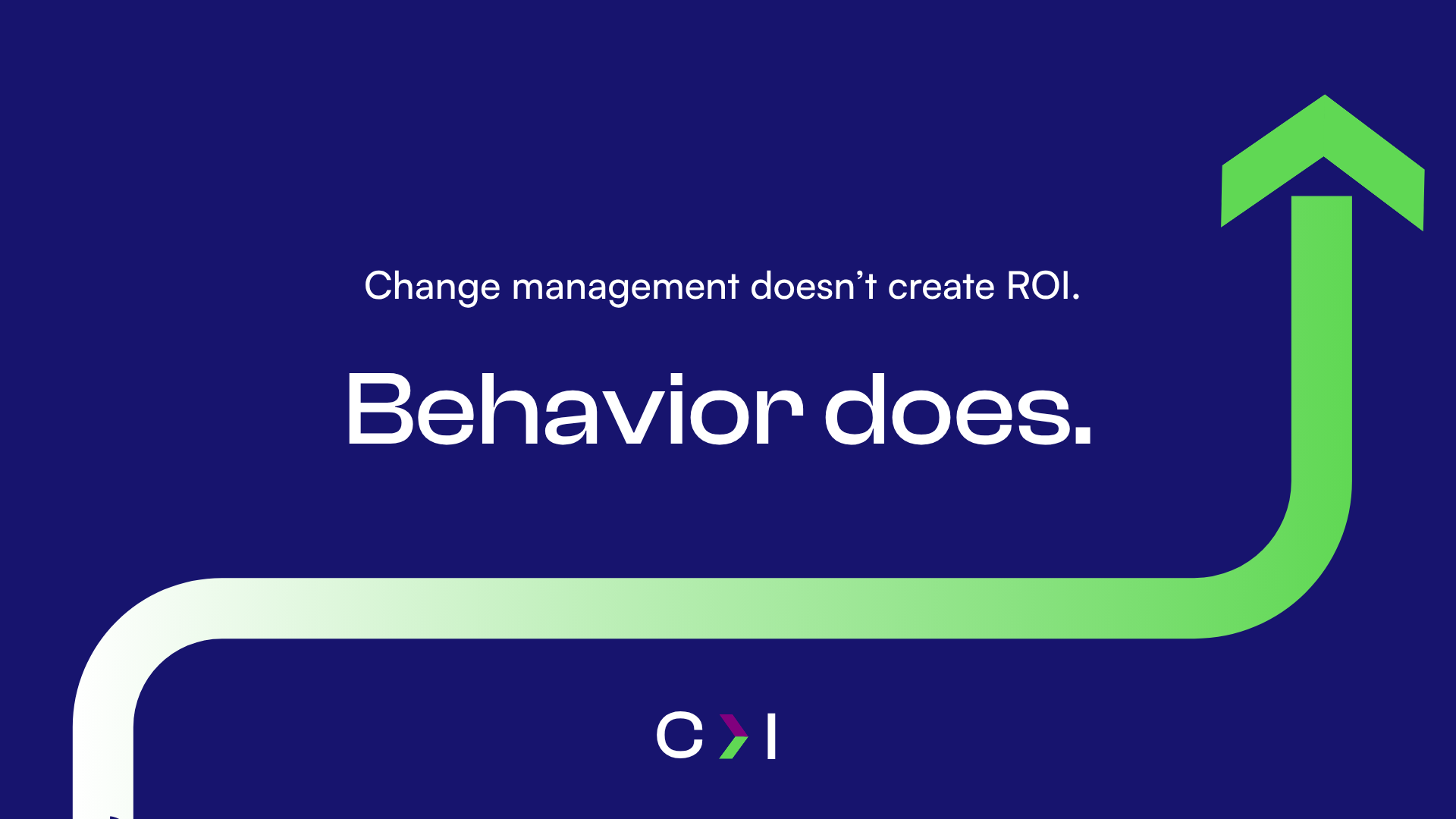
Reads “change management doesn’t create ROI. Behavior does” with an arrow showing an upward trajectory to symbolize improvements to ROI.
Sometimes change management gets a bad name.
It uses “people-y” language in a tech-driven world and most organizations already have teams who can write emails, create presentations, and coordinate training sessions. As a result, change management is often viewed as a support function rather than something that directly drives business results.
There’s a reason for that.
But it’s not because change management isn’t valuable. It’s because most change management initiatives are missing a crucial piece.
Organizations are driven by people, and people have behaviors. Every action is a behavior: from going to a meeting, to using an internal ticketing system, to getting sponsorship for a new strategic initiative.
When an organization invests in change management, they aren’t just interested in letting people know that something different is about to happen. They want their employees to behave differently because a change in behavior means quicker delivery, happier stakeholders, and an increase in ROI.
If the goal of change management is ultimately to improve business outcomes, a messaging campaign isn’t going to do that.
So, instead of just asking, "Do we have change management covered?" a better question is:
"How are we going to get people to change their behavior long-term?"
If your answer doesn't include behavioral science, sustaining a change becomes much harder.
What Behavioral Science Actually Means
What do you picture when you hear the term “behavioral science”?
Maybe it’s a university professor conducting psychological experiments. Or maybe it’s the nudges used to get people to buy things in an app.
The truth is, behavioral science isn't just something that happens in a laboratory. It's a practical way of understanding why people adopt new behaviors, maintain old ones, or resist change altogether.
Since change management is ultimately about helping people behave differently, behavioral science has a lot to contribute.
Why Communication and Training Aren't Enough
Most change management activities focus on communication, training, and stakeholder engagement. These activities are important, but they don't directly change behavior.
Think about the last mandatory training you attended. You probably understood the material. That doesn't mean you changed what you did the next day.
Knowledge and performance are not the same thing.
We work alongside teams that are familiar with frameworks like ADKAR to guide change initiatives. These frameworks help identify where people may need support, but behavioral science helps answer a different question:
What do we actually do about it?
We start with a change readiness assessment to identify the areas that present the greatest risk to adoption. Not every project has the same challenges. One organization may need stronger leadership alignment. Another may need clearer expectations, better accountability, or more support after go-live.
Once we understand where the gaps are, we can focus on the interventions that are most likely to make a difference.
Depending on the need, that might include:
Process maps to make expectations clearer
Scorecards to measure adoption
Governance structures to clarify ownership and accountability
Quality review systems to monitor performance
Manager coaching tools to support leaders
Adoption dashboards to track progress
Feedback systems so people know how they're doing
Workflow changes that make the desired behavior easier to do
The goal isn't to check a box and say change management is complete. It's to identify the factors influencing behavior and design interventions that address those factors directly.
The Difference Between Implementation and Impact
At Change Impact Partners, we work hand-in-hand with implementation teams to facilitate smooth rollouts, long-term adoption, accountability, and governance.
Our consultants are Board Certified Behavior Analysts who bring experience in change management, process improvement, and technology implementations. They hold technical certifications and have worked directly on implementation teams, which gives us a unique perspective on both the technical and human sides of change.
At the end of the day, organizations don't invest in change for the sake of change. They invest in change to improve performance, solve problems, and achieve better business outcomes. Our role is to help make sure those outcomes don't get lost between implementation and execution. Because if people don't work differently after the project is over, the change didn't really happen.
How do you make sure your change management efforts are actually tied to business results?
Zendicoded Rebrands as Change Impact Partners
Press release regarding Zendicoded’s rebrand to Change Impact Partners.
Expanding Focus on Behavioral Science and Change-Driven ServiceNow Implementations
Salt Lake City, Utah - Monday April 20, 2026 — Zendicoded, Inc., a ServiceNow Consulting and Implementation Partner, today announced that it will operate under a new name, Change Impact Partners, effective immediately.
The rebrand reflects the company’s continued evolution and sharper focus on helping organizations design and implement systems that function effectively in real-world operating environments.
“Over the past several years, we’ve worked with organizations that have made significant investments in technology, but still struggled to see the outcomes they expected,” said Kristyn Peterson, CEO of Change Impact Partners. “What we consistently found is that successful implementation requires more than a well-configured platform. When we consider the people and the processes that support how people actually work, organizations can unlock the value their technology enables”.
The newly named Change Impact Partners will continue to serve clients across industries including banking and healthcare, with a focus on ServiceNow implementations, Organizational Change Management, and system design. The company differentiates itself through its integration of behavioral science principles into technology and process design, addressing common gaps between system intent and real-world execution.
While the company’s name has changed, its core team, leadership, and service offerings remain consistent.
“Our work has always sat at the intersection of people, process, and technology,” Peterson added. “This change allows us to better represent that approach and the value it brings to our clients.”
The transition to Change Impact Partners will not impact existing client engagements, partnerships, or service delivery.
About Change Impact Partners
Change Impact Partners is a ServiceNow Consulting and Implementation Partner focused on designing systems that work in real-world conditions. The company specializes in integrating behavioral science and change management into system design, helping organizations improve adoption, execution, and long-term value from their technology investments.
Change Impact Partners works with organizations across regulated industries, including banking and healthcare, to align people, process, and technology for sustainable operational performance.